HexaGo® vs. Classic Helmet: How a Helmet Protects Your Brain, Not Just Your Skull
Share
Every bike helmet sold in Europe has to meet the EN 1078 standard. Even so, helmets differ hugely in how much impact energy actually reaches the brain. In this article, we explain step by step what happens inside a helmet during an impact and why 720's HexaGo® technology works differently from a classic helmet.
1. A helmet's job: buying time
When your head hits the ground, it has to slow down from, say, 20 km/h to zero in just a few thousandths of a second. The shorter this stopping distance, the greater the force on your brain. This force is measured in g (multiples of the Earth's gravity).
At its core, a helmet has just one job: to lengthen the stopping distance. It deforms so that your head comes to a stop a few millimetres more "gently". Think of it this way: jump onto concrete and it hurts. Jump onto a gym mat and it's comfortable, because the mat lengthens the stopping distance.
2. What injures the brain
For the brain, two types of acceleration matter:
- Linear acceleration (straight impact): mainly associated with skull fractures and bleeding directly beneath the point of impact.
- Rotational acceleration (twisting): the brain is twisted and sheared inside the skull. This is considered the main cause of concussion, diffuse axonal injury (DAI) and subdural bleeding from torn bridging veins.
In real cycling accidents, the head almost always hits the ground at an angle. So both forces almost always occur at the same time. Find out more in our article "Brain Injuries in Cycling Accidents and Falls".
3. The classic helmet: EPS (foam)
Most helmets are made on the inside of EPS (expanded polystyrene, the white foam you know from packaging): thousands of tiny foam beads fused together that get crushed on impact.
What EPS does well
- light and inexpensive
- spreads a straight impact over a large area, giving good protection against skull fractures
Where EPS hits its limits
- Fairly stiff: EPS has to reach a certain force before it gives way. Until then, some of the energy is passed straight to the head.
- Single-use protection: EPS is permanently compressed and doesn't spring back. A second impact in the same spot, for example when you roll over, is barely cushioned.
- Little rotational protection: A rigid foam body grips the head and passes on twisting movements almost unchecked. That's why many manufacturers add extra slip liners.
On top of that, the EN 1078 standard mainly tests straight drop tests. So a helmet can pass it without offering particularly good protection against rotation.
4. The 720 helmet: HexaGo®
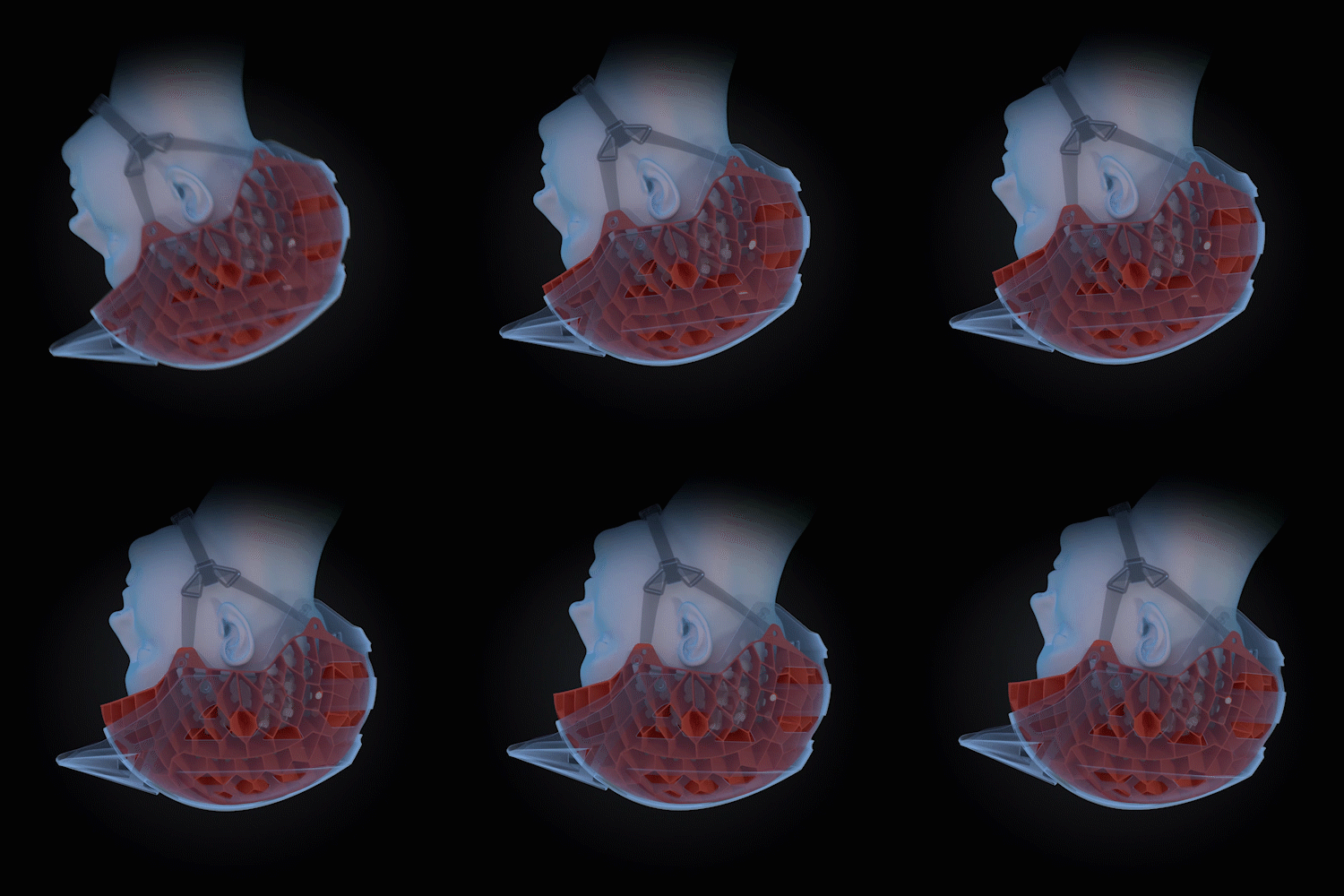
HexaGo® is a patented honeycomb core made of H.E.A.P. (High Energy Absorption Polymer), an elastic plastic that returns to its original shape. The honeycomb shape is found in nature (beehives) and in aerospace engineering: it's extremely strong for its weight and can absorb energy very evenly.
How HexaGo® works on impact
- Controlled buckling: The honeycomb walls deform step by step. This means the force on your head doesn't spike suddenly but is spread over a longer stopping distance.
- Energy distribution: The honeycomb structure spreads the energy over a large area instead of passing it to one point on your head.
- Sliding against rotation: The honeycomb core can move and deform inside the outer shell. This absorbs part of the twisting motion before it reaches the brain. This rotational protection is built right in, with no extra liner.
- Shape recovery: After an impact, the structure returns to its original shape and can still cushion a second impact in the same crash.
On the outside, a tough shell (polycarbonate on the AWAKE, PRP polymer on the CIRCLE) protects against penetration and sharp edges.
5. Head-to-head comparison
| Classic EPS helmet | 720 with HexaGo® | |
|---|---|---|
| Material | rigid polystyrene foam | elastic honeycomb core (H.E.A.P.) |
| Straight impacts | good against skull fractures | good against skull fractures and gentler deceleration |
| Rotational forces | only with an add-on system | built right in |
| Multiple impacts | protection at that spot greatly reduced | returns to shape |
| Force on the head (lab test) | avg. approx. 171 g* | approx. 111 g |
| EN 1078 limit | 250 g | |
* Average value according to Folksam data. 720 value from lab tests using the EN 1078 method. After any serious crash, every helmet, including a 720 helmet, should be replaced.
6. What does 111 g instead of 171 g mean for the brain?
The lower the g-value, the less strain reaches the brain. Research shows that the risk of concussion rises significantly as acceleration increases. So less acceleration means a lower risk of injury. At around 111 g, a 720 helmet comes in at less than half the permitted limit and well below the average for classic helmets.
No helmet can prevent every injury. But every g that doesn't reach your brain counts.
7. The bottom line
- A classic EPS helmet is mainly designed to protect the skull from fracturing.
- But many serious consequences happen in the brain, often due to rotational forces and often without a broken bone.
- HexaGo® cushions straight and rotational forces, recovers its shape after an impact and, in lab tests, passes significantly less force to the head.
→ More about HexaGo® technology | View all 720 helmets
Note: This article is customer information from 720 Protections, not a medical text. It is for general information only and does not replace medical advice. The measured values given come from lab tests under standard conditions; real-world accidents may differ.